














Below, Daisy Dixon shares five key insights from her new book, Depraved: The Story of Dangerous Art.
Daisy is a philosopher and artist with a PhD from the University of Cambridge. She is a lecturer in philosophy at Cardiff University, specializing in the philosophy of art, particularly the collision between aesthetics and ethics.
What’s the Big Idea?
Art has always helped us confront the darkest parts of human nature, from violence and obscenity to oppression and cruelty. But art can also reinforce those very harms, shaping what we desire, tolerate, and believe about one another. The answer is not to censor immoral art or pretend we can separate it from the people and values that produced it, but to confront it directly. By understanding its depravity, challenging it, and responding with better art, curation, and education, we can strip harmful art of some of its power while preserving what it can teach us about ourselves.
Listen to the audio version of this Book Bite—read by Daisy herself—in the Next Big Idea App, or buy the book.


1. Obscenity.
From the very beginning of artistic creation, humans have depicted violence, sex, and the naked body. One archeologist describes the Paleolithic period as “sex mad.” Much of this art has since been deemed obscene and unsuitable for the public, but those judgments rarely hold up under scrutiny.
A Paleolithic sculpture of the female body discovered in 2008 in Germany was branded by both the press and scientific institutions as “the world’s first page-three girl”—smut carved from a mammoth tusk, a prehistoric pinup. The 18th-century Marquis de Sade’s novels, which eroticize extreme sexual violence, were banned by Napoleon and then burned to ashes by Sade’s own son.
But what actually makes something obscene? Something is obscene when it severely violates a moral norm and invites or arouses pleasure in that very violation. An artwork is obscene when it asks us to find something repulsive intensely pleasurable. For instance, de Sade’s erotic literature invites the reader to be aroused by rape, sexual cannibalism, and necrophilia.
History shows, however, that such judgments of art can often betray deeper prejudices and double standards. Queer art throughout the 20th century was banned for its supposed obscenity simply because it championed love and sex that diverged from the heterosexual norm. In 2014, artist Megumi Igarashi became the first woman in Japanese history to be charged with obscenity for her vulva sculptures. Meanwhile, enormous penis sculptures paraded at Japanese phallic festivals were considered perfectly acceptable by the same authorities. More recently, Cardi B and Megan Thee Stallion’s song “WAP” was denounced by right-wing commentators as pure depravity, when the song is simply a bombastic ode to female pleasure.
We must be careful how we judge the obscene. Denouncing a work of art as obscene ranks it as inferior art and reveals society’s attempt to control who has ownership over sex, and whose bodies are acceptable.
2. Criminality.
A scene from the Roman comedy Eunuchus by Terence, written in the second century BCE, follows a young Athenian man named Chaerea as he enters a household under false pretenses, disguised as a eunuch. As a slave girl named Pamphila prepares a bath, the two gaze at a painted panel in the chamber. The painting depicts the moment Jupiter impregnates Danaë with a golden shower from above. Chaerea, overcome with lust inflamed by the painting, rapes Pamphila.
This ancient play demonstrates the power of images to seduce us into the most abominable acts. Chaerea directly imitates Jupiter—the principal seducer in ancient Greek mythology. And while the story is fictional, it speaks to the potential danger of art’s influence on our behavior.
“This ancient play demonstrates the power of images to seduce us into the most abominable acts.”
For ancient Greek and Roman audiences, it was thought that actors onstage and sculptures had an almost magical quality, inducing the world to imitate the art. Plato worried that emotional poetry and music could corrupt our rational faculties. Today, there are many concerns that hyperrealistic, self-involving video games are poisoning our minds and causing real-world violence. Studies do show that violent or bigoted video games played habitually can increase aggressive thoughts and reinforce harmful stereotypes about women and people of color.
But we must be careful about which art we allow to be swept up by moral panic. Drill music is frequently denounced for causing real-life violence among Black youth in the UK, despite there being no evidence for this. Some artworks might be brutal eye-openers rather than dangerous fire-starters.
3. Oppression.
Titian’s Rape of Europa depicts Jupiter, disguised as a white bull, abducting Europa from her family and home before impregnating her. Commissioned by King Phillip II of Spain for his erotic art collection, the painting eroticizes the rape and blurs consent: Europa resists the assault, yet in a way that is dripping with sensuality.
Not everyone in the royal household enjoyed it. Philip IV’s wife, Queen Elizabeth, apparently found the sexuality of the inherited collection so disturbing that she would order the paintings covered whenever she visited her husband. Her reaction might seem prudish, but that may be an unfair judgment. Perhaps her reaction was indicative of many women’s frustration at the double standards and sexism in the art world. Back then, women were not permitted to attend art school or receive formal training. Yet gallery walls were brimming with naked girls, often in passive positions or being sexually violated.
Artworks like these tell stories in ways that shape social reality. In some cases, they function as a kind of hate speech. The Jim Crow-era bric-a-brac and entertainment of the 19th and 20th centuries depicted Black people as dimwitted, hypersexual, or grotesque—dehumanizing them and entrenching anti-Black stereotypes across objects ranging from so-called high art to low art.
Artworks are not inert, passive things that are simply pleasant or unpleasant to experience. They are active, living things that are intimately part of our world, and they massively affect how we treat one another. And sometimes it is the most beautiful art that can be the most insidious.
4. Malevolence.
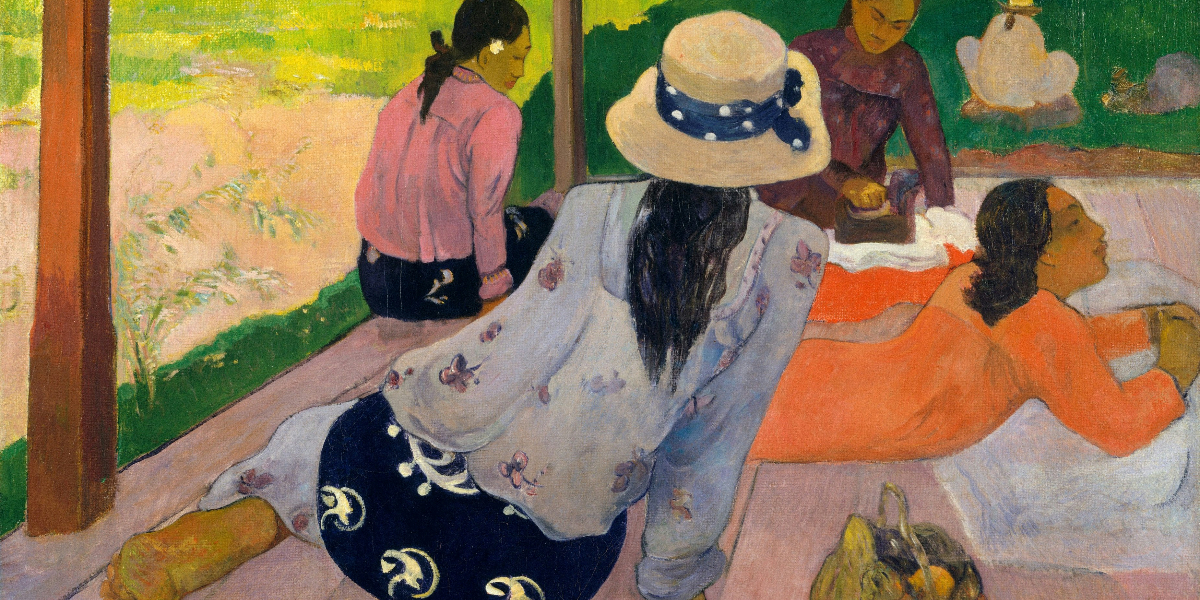
Paul Gauguin was a renowned 19th-century French Post-Impressionist. He was also a sexual predator. When living in the South Pacific, where he created some of his best-known paintings, he used his colonial privilege to sexually abuse girls as young as 13. Art historians note how Gauguin’s sexualized attitude toward his child brides is noticeable in his portraits of them, such as Spirit of the Dead Watching, which shows one of his wives, Teha’amana, lying in what the artist himself described as pure fear.
“To fully appreciate the artwork’s character, we do need to look to the artist.”
Until recently, the reality behind Gauguin’s exotic and bright portraits was largely ignored. The focus remained on the paintings themselves and their innovative style. But shouldn’t we pay more attention to the artist behind the art?
In opposition to popular views, I don’t think we can separate the art from the artist. Artworks are special objects with particular histories. Their identity and meaning are partly formed by the social and political surroundings in which they were created—which includes the identity and character of their creator. This isn’t to say that an artist’s intentions exhaust the meaning of their work, but to fully appreciate the artwork’s character, we do need to look to the artist.
Sometimes that moral character is explicitly evident, like in Gauguin or Picasso’s eroticized portraits of lovers whom they abused. Sometimes it is evident in style alone: Hitler’s seemingly innocent, peaceful landscapes and painstaking depictions of traditional architecture in fact betray his harrowing worldview. Even in cases where the artist’s character is not legible in the work’s meaning, these objects have still been given to the world by a problematic person. It is our choice whether we continue to appreciate such works.
5. Iconoclasm.
What do we do with immoral art? Such art can harm people in the real world and poison our minds, but blanket censorship is not the way forward.
Suppressing harmful representations often causes them to breed underground. And censorship has sometimes caused more harm than good. From the Nazi’s control of artistic expression to present-day political attacks on cultural institutions, great and truthful art has been destroyed in bids to manipulate a nation’s stories and silence dissident voices. Banning or destroying art made by immoral artists would mean a loss of greatness and perhaps even beauty. Even genuinely despicable art like that of the Marquis de Sade’s has value for humanity. In its shameless presentation of the darkest desires, philosophers, historians, and artists have been inspired by de Sade’s libertine philosophy—where pleasure and pain are the only real values—as well as his art’s biting satire of the ruling classes during the French Revolution.
“Suppressing harmful representations often causes them to breed underground.”
So rather than traditional iconoclasm, I propose an alternative: metaphysical iconoclasm. By speaking back to immoral art, we can disarm its toxicity head-on. Responding creatively to our depraved heritage via more art, ethical curation, and better education can drain it of its power and reduce it to an inert thing—or transform it into something new. Destruction without physical destruction.
Only by understanding the long history of depraved art can we begin to bring our own age into focus. Art can be dangerous, but censorship can be equally catastrophic. We should not abandon our favorite artists or burn our immoral books. Instead, we must confront their depravity, scrutinizing the insights they give us into the darkest corners of the human condition.
Enjoy our full library of Book Bites—read by the authors!—in the Next Big Idea App: