












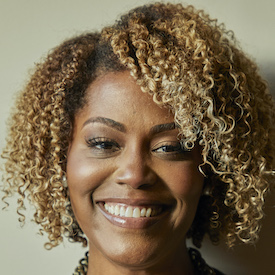
Below, Marisa Renee Lee shares five key insights from her new book, Waiting For Dawn: Living With Uncertainty.
Marisa is a social impact consultant. Prior to launching her consulting practice and becoming an author, she was a Deputy Director in the Obama White House and Managing Director of President Obama’s My Brother’s Keeper Alliance.
What’s the big idea?
Uncertainty disrupts who we are and how we live, but by accepting change, leaning on others, and practicing grounded hope, we can endure and move forward.
Listen to the audio version of this Book Bite—read by Marisa herself—in the Next Big Idea App, or buy the book.


1. Uncertainty is a form of grief.
I developed the term Gray Grief to help explain what uncertainty really is and what it feels like. Gray Grief is murky and uncertain like the sky before a storm officially announces itself. Like a dense and heavy fog that appears when you’re driving at night. I define uncertainty as a feeling of stress or overwhelm related to the unknown.
When uncertainty of any kind enters your life—divorce, serious illness, infertility, job loss, and so on—everything becomes heavy and murky and gray. Oftentimes, when uncertainty hits, we like to act as though we are fine, and life is still perfectly normal. When I remained ill after my COVID infection, I refused to face the reality that I had Long COVID. I camped out in the land of denial for a few months, making myself worse and delaying my treatment.
2. Uncertainty often changes your identity.
Over the course of our lives, our identity is meant to shift and change. We become graduates, get new jobs, maybe take on the title of mother or father, move to new places, and so on. These changes can be challenging, but they aren’t upsetting because you are in control. These are choices.
Uncertainty forces an identity shift because, almost always, something is lost. This loss could be your time and flexible schedule when you begin caring for an aging relative. Or it could be your relationship status when your husband walks out after 20 years. Maybe it’s the loss of your ability to conceive a child naturally. When these types of identity shifts take place, we often want to fight them, but what we must do instead is focus on our immutable states of being, the things about us that never, ever change.
“Uncertainty forces an identity shift because, almost always, something is lost.”
When I was first sick with long COVID, I discovered I couldn’t cook anymore. The brain fog was so debilitating that my internal chef clock, which I had relied on since childhood, simply disappeared, and I kept burning bacon. It seems like such a minor thing, but that burnt bacon was symbolic of the myriad changes to my identity that I had to learn to accept. So, I had to focus on the things that will never change, the things I hope people talk about at my funeral: my generosity, my commitment to joy, my vanity, my love of a good piece of cake or a dance party. Who you are at your core cannot be erased due to a period of uncertainty.
3. It’s okay to flake.
When uncertainty enters the room, your life changes, your capacity changes, your capabilities are altered, and some previously held commitments must simply fall by the wayside. You need to clear the decks to deal with whatever has shaken up your life. Set your priorities, address your personal needs, and forget about the rest. Sometimes it is the only way you get through it.
In 2023, our family was living through an extended period of uncertainty as my mother-in-law lay dying from breast cancer (the same thing that killed my mom) several states away. It was a devastating time, and it got much worse. In the middle of it all, my young cousin went missing and was later found killed by her partner. During this season, I was supposed to lead a grief retreat. I clearly had no capacity for anyone else’s grief when I barely had capacity for my own, so with sweaty palms and a silent prayer, I called the retreat hosts and told them I didn’t feel that I could do this anymore. Their response—“We wondered how you would do this with all that your family is going through”—was a reminder that when we are honest about what we need, then we can be met with compassion and understanding.
4. Uncertainty requires help.
So many of us are so bad at asking for and accepting help. We are usually more than happy to help others, but when it’s our turn, we worry about being judged. We worry about people thinking we are weak, lazy, or incapable, as opposed to simply human.
There is something called the Superwoman Schema developed by Cheryl Woods Giscombe to show the detrimental effects on the health and well-being of Black women who refuse to ask for and accept help and instead continue to give from an empty well. The health consequences are devastating, and this is true for all of us. Playing superwoman or superman helps no one. Ask for and accept help so you survive this period of pain and uncertainty.
“The health consequences are devastating, and this is true for all of us.”
Human beings evolved in a community for a reason. We are meant to rely on one another during normal times, so we definitely need to rely on one another when life gets hard. I want you to put shame and self-judgment aside and ask for help.
5. Living well with uncertainty requires hope.
We often think of hope as this light, ephemeral, adorable little thing akin to optimism, but that’s not what it is at all. Hope is a disciplined practice. It is not light, cheerful, or a synonym for optimism. It is the energy that drives us forward when life feels impossible. Hope is the fuel that keeps you moving toward a better future.
The hope we seek must be rooted in our current reality, and it must be paired with action if you want it to produce meaningful change. The hope that I speak of is embedded in my DNA. In the 1940s, my grandfather—my Pop Pop—was a man with a 6th-grade education who was a hard worker and a leader in the fields where he worked in Statesboro, Georgia. He believed in his heart that staying down South was not the right decision, nor the safest one, for his family. So he decided to leave Georgia for a new opportunity in Florida, with the ultimate goal being a move North.
The night before they were set to leave Georgia, the white man who owned the fields where my Pop Pop worked showed up at my grandparents’ home with a few of his buddies and trace chains—the thick metal chains used to attach a horse to a wagon. Their intent was to beat him into submission and force him to stay and work for them. My grandfather met them at his front door, shotgun in hand. The men left, and the next day, my grandparents, uncles, and aunt left Georgia. A few months later, his opportunity to move “up North” arrived in the form of a man from the Hudson Valley with a job offer. My family became a part of the six million Black Americans who fled the blatant racial terror and constant violence of the South, for the quiet and subtle racism of the North during The Great Migration.
“Hope is the fuel that keeps you moving toward a better future.”
If not for my grandfather’s commitment to hope, his trust that something better must exist for him and for his family, and his willingness to do anything he needed to make that future a reality, I would not be here. I am confident that my Ivy League degree, my books, my economic stability and mobility, my physical and emotional safety are all derived from his hope and his shotgun. A shotgun that saved generations. He knew there had to be something better, and he made a commitment to finding it by any means necessary.
Enjoy our full library of Book Bites—read by the authors!—in the Next Big Idea App: