










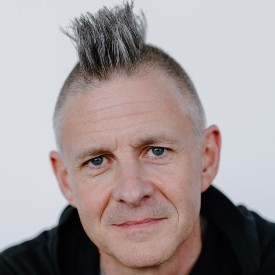
Below, Eric Zimmer shares five key insights from his new book, How a Little Becomes a Lot: The Art of Small Changes for a More Meaningful Life.
More than twenty years ago, Eric was a homeless heroin addict in a treatment center, trying to figure out how to make it through a single day without using, while also facing a prison sentence. Now, he is a behavior coach and hosts an award-winning podcast, The One You Feed. Through his workshops and mentorship, he has guided thousands worldwide in creating habits that last.
What’s the big idea?
Why is change so hard, even when we want it? Lasting change usually isn’t a breakthrough. It’s a gradual practice that starts small. You don’t need a new personality—you need better strategies and repeatable practices that work with how your mind actually operates.
Listen to the audio version of this Book Bite—read by Eric himself—in the Next Big Idea App, or buy the book.

1. Little by little, a little becomes a lot.
You’ve heard some version of this idea: Rome wasn’t built in a day, slow and steady wins the race, you eat an elephant one bite at a time. And yet, when we attempt change in our own lives, we can’t help but hope for faster results—the silver bullet, the epiphany, the makeover montage. But the good news is that meaningful, lasting transformation doesn’t take a lightning-strike miracle or willpower of steel. Little by little will become a lot.
When I say, “little by little,” I specifically mean low-resistance actions, done consistently over time, in the same direction:
- Low resistance is about choosing actions we’ll actually do.
- Consistency is about repetition.
- In the same direction means that all the little steps are headed toward the same thing.
The harder something is to do, the more motivation we need to tackle it. The easier it is, the less motivation we need to get started. We can think of the combined challenge posed by difficulty and motivation as our overall resistance to a given action.
There are two ways to lower that resistance. The first is to raise our motivation level, which is easier said than done. Motivation is more a feeling than anything else, and feelings don’t have levers you can pull. The other way? Make the behavior easier. Make it smaller.
Let me give you an example from this very morning. I was groggily scrolling through the New York Times, wanting to do anything but ride my bike. I had this internal negotiation: “Okay, it’s time to do our one-hour ride.” And my brain said, “Are you nuts?”
“Make the behavior easier. Make it smaller.”
But instead of trying to pump myself up, I changed the task. Instead of “Get on the bike and ride for an hour,” I made it “Just put on your bike shoes and clip into the bike.” And I got on the bike and started pedaling.
We believe we get motivated and then act, but often it works the other way around. We act, and motivation follows. As the saying goes in 12-step programs: “Sometimes you can’t think your way into right action. You have to act your way into right thinking.”
2. Change is a skill you can learn.
Most people don’t fail at change because they’re lazy. They fail because they’re trying to solve a skills problem with shame and willpower.
That framing matters because when we treat change like a character issue—”I’m just the kind of person who…”—we’re already halfway to quitting. As a coach, I heard that sentence constantly: “I’m just the kind of person who can’t stick with anything,” or “who has no willpower,” or “who never finishes what I start.” Those beliefs get so ingrained that they start to feel like facts. Once they feel like facts, we behave like they’re true.
Writing this book brought me levels of self-doubt I hadn’t faced in a long time. With each new page, my brain would ask, “Who are you to offer wisdom to anyone?” or “Is there a more boring sentence outside of an accounting textbook?” And once that voice gets going, avoidance gets tempting. So, we work through that as follows:
- We work with negative self-talk, not against it. This is where a lot of self-help veers into “positive thinking.” Full cheerleader mode has never worked for me. I’ve found it easier—and just as effective—to aim for neutral. Instead of “I can definitely do this,” I ask: “Do you know you can’t?” And even my most pessimistic self has to admit the answer is no, I don’t know that. I might not believe I can, but I no longer believe I can’t, which is a place to start.
- We shift how we label obstacles. A.J. Jacobs once told me he loved a quote from Quincy Jones: “I don’t have problems, I have puzzles.” A problem feels heavy and final. A puzzle is an invitation. You roll up your sleeves and work on it. You assume there’s a way through—even if you can’t see it yet.
- We stop using self-judgment as our main fuel source. Yes, self-criticism is a type of fuel. But it burns dirty and eventually gunks up the engine. Learning doesn’t happen in states of stress. Judgment collapses our consciousness. We lose the ability to experiment, adjust, and learn from mistakes—the exact things that change requires.
If you’ve struggled to change, the most accurate conclusion usually isn’t that something is wrong with you. Rather, you’ve just been using the wrong strategy or missing a few skills.
3. What you want most vs. what you want now.
Our inner motivational landscape is far more complex than that question suggests. We have a complex interplay of needs, wants, beliefs, and values swirling inside us. But for practical purposes, I’ve found it most useful to boil it down to two basic camps: your values—what you’ve decided is worth wanting—and your desires—what you want, whether you like it or not. Values are what you want most. Desires are what you want now. The gap between them is where much of our struggle lives.
One of the most common ways desires win is what I call the Shortsighted Stumble—when our only perspective is now. Researchers call this delay discounting, which is a fancy way of saying we value immediate gratification over longer-term effects.
There’s a classic episode of The Simpsons where Marge tells Homer that someday he’ll regret not spending more time with the kids. Homer replies, “That’s a problem for future Homer. Boy, I don’t envy that guy”—before pouring vodka into a mayonnaise jar, shaking it up, and slugging it down. This disgusts even me, a former alcoholic who drank rotgut wine that never saw a grape. But the scene gets to the core of this pitfall: we’re not thinking of our future self, or the future at all.
In recovery, we used a technique called “playing the tape all the way through.” Don’t stop at the first frame, which shows how good it would feel to do the easy thing. Keep going. Picture what happens after.
“The goal is to see and feel the likely consequences of your present choice.”
I might suddenly have a craving to get high, and all I’d be thinking about is how good it would feel. Playing the tape through means thinking about what comes next. I might feel good for a few hours, but then I would want to get high again, with even more intensity. And I didn’t have any money, which would mean I’d have to steal something, and oh yeah, I was already facing fifty years of prison time.
Most of us aren’t on that trajectory, but the same principle applies. If you’re tempted to hit snooze again, picture the next scene: the frantic scramble, the awkward slide past your boss’s office, the slow burn of shame that hangs around all morning. Suddenly, pulling off the covers doesn’t seem so bad.
The scientific term for this is episodic future thinking—imagining in detail experiences that might yet happen to you. The goal is to see and feel the likely consequences of your present choice. Because change doesn’t usually come down to knowing what you want most. It comes down to remembering it at the exact moment you want something else.
4. YOU are the meaning maker.
One of my favorite phrases of all time comes from Anaïs Nin, who wrote: “We do not see things as they are, we see them as we are.”
For us humans, there’s simply no such thing as an objective view of reality. Even when we think we’re seeing all the facts, we’re always seeing them through the colored lens of our own perspective. There is no view from nowhere—no perfectly removed perch from which we can see all angles at once. And when we forget that—when we assume the way we’re seeing the world is just the way it is, rather than the way it looks to us—we can cause ourselves a lot of needless suffering.
Your mind is a projector, screening a movie onto the world around you that is a blend of your memories, expectations, and interpretations. Rather than seeing raw reality, you see a story whose plot, characters, and even genre are shaped by your past experiences, cultural background, emotional state, and personality traits. Someone else watching the same screen would see a completely different movie.
It would be nice if we could just take the glasses off completely, but that isn’t possible. What we can do is find the edges of the frames and remember that other views exist. We can begin working with perspective by asking three simple questions:
- What am I making this mean? This makes us aware that we’re actively creating meaning. It usually happens automatically, and subconsciously, so this question catches the mind’s meaning-making machine in the act. Sometimes the question alone is enough to make us reconsider our conclusions.
- What else could it mean? “Could” is key. The goal isn’t necessarily to replace your interpretation. It’s to recognize that other interpretations are possible.
- What meaning is most useful? We never have all the facts. If I’m creating the meaning, and several meanings could fit, why not choose the one that empowers me and reduces suffering?
Much of our suffering comes from the meaning you’re making, not the facts themselves. These three questions interrupt your meaning-making machine and give you back the power to choose your interpretation.
5. Extreme language produces extreme emotions (and behavior).
This morning I woke up with some back pain, and my first thought was, “My back is killing me.” It’s obviously hyperbole, but that’s the point: extreme language produces extreme emotions. When my inner narration goes dire, my emotions follow it—and then my behavior follows the emotions. A better internal conversation would be—eyeroll emoji—“I feel your pain, Eric, but a tight lumbar is unlikely to cause your death.” The best way to move forward with my day was to scale back how I was describing the pain to myself.
Or take this classic: “I can’t believe they did that!” Think about that statement. You can believe it. You just would have chosen for that person to act differently. Try rephrasing to: “I wish they hadn’t done that.” If you’re auditioning for The Real Housewives, you may want to stick with the original, but assuming you want a calmer existence, try the reframe.
Extreme language produces extreme emotions. More measured language creates space for a more balanced, middle-way perspective. I never thought I’d be treating the lessons of third-grade English like a red-string conspiracy board, but adjectives, adverbs, and pronouns can become little bombs of extremity in our descriptions of reality:
- Adjectives like horrible, disastrous, and unbearable can tip “this is unpleasant” into despair.
- Adverbs like always and never turn a messy reality into an on-off switch. Want to turn a discussion into a fight? Accuse the other person of always or never doing something. It works like a charm. Inside our own heads, they sound like: “I always mess up,” “I never finish anything I start.”
- Pronouns plus absolutes—everyone and no one—turn a bad moment into a global verdict: “No one loves me.” “Everyone thinks I’m stupid,” after a presentation to five people goes a little less well than you hoped.
When you notice these red-flag words, experiment with substitutions that reflect the nuance of reality: “That was unpleasant.” “I’m having a hard time right now.” “Sometimes I feel like you’re not hearing me.”
The goal isn’t to gloss over what’s hard. It’s to remind ourselves that reality is rarely black and white. There are real benefits to seeing in full color.
Enjoy our full library of Book Bites—read by the authors!—in the Next Big Idea App: